-Editorial
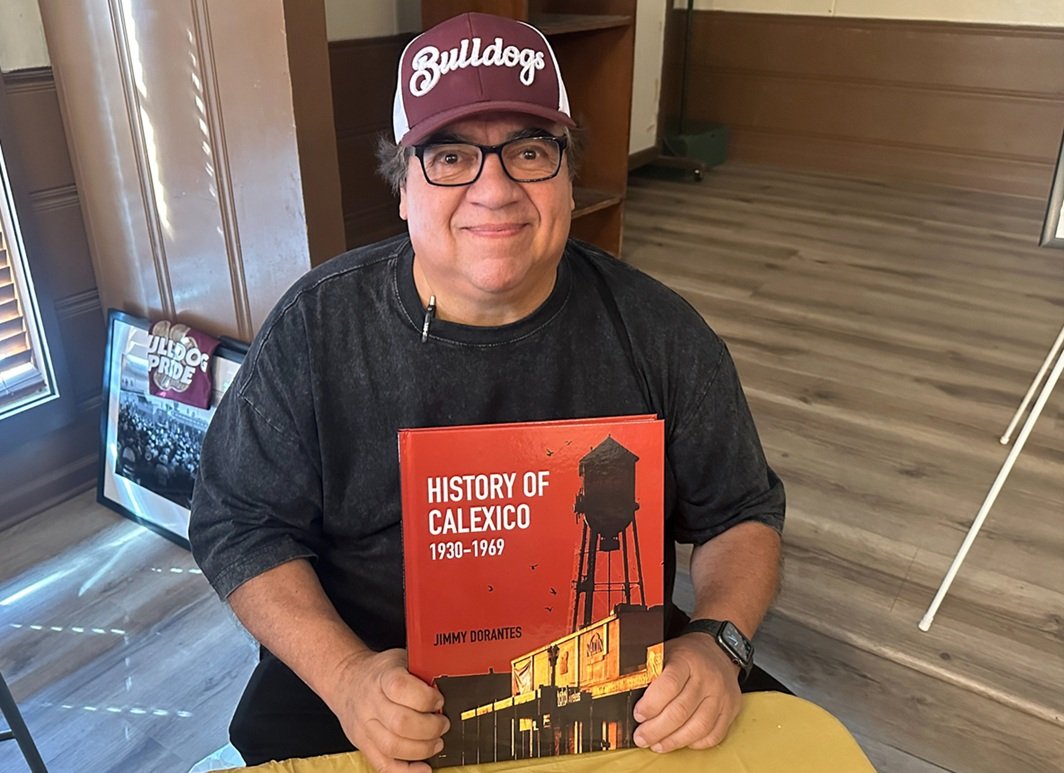
The Calexico Arts Council has released the second installment in its ongoing local history series, History of Calexico 1930–1969, a comprehensive work written and produced by Jimmy Dorantes that captures nearly four decades of life in the border city through archival research, photographs, and personal narratives.
The book was formally presented to the community as part of the council’s effort to document and preserve Calexico’s past. Building on the first volume, which explored earlier periods of the city’s development, the new edition focuses on a transformative era marked by economic hardship, wartime experiences, and postwar growth.
Within its pages are stories that reflect the breadth of Calexico’s identity, from the challenges of the Great Depression to the achievements of residents who found success in business, education, and public service. The book also highlights moments of community pride, including high school football victories that brought residents together and helped define a shared sense of belonging.
 Dorantes, a photographer by trade who grew up in Calexico, said the project became more complex than originally anticipated. What began as a short-term effort evolved into a year-and-a-half process as he worked to gather reliable historical information and verify sources.
“At first, I thought it would take six months,” Dorantes said in an interview. “But once I began researching, I realized how much work it would take to tell these stories accurately.”
Documenting the 1930s posed a particular challenge due to the limited number of firsthand accounts. Dorantes said he relied heavily on archived editions of local newspapers to reconstruct events and understand the economic and social conditions of the time, including major developments such as the construction of the All-American Canal.
As the timeline moved into the 1940s and beyond, the research process shifted to include oral histories. Dorantes conducted interviews with family members of World War II veterans and longtime residents, allowing him to incorporate personal stories that added depth and context to the historical record.
Visual elements play a central role in the book. Many of the photographs were sourced from institutions such as the Pioneers Museum, as well as school archives and private collections. Dorantes said his professional background in photo research helped him navigate copyright requirements and locate images that reflect the era.
The book also emphasizes Calexico’s unique position as a border community, where daily life is shaped by the intersection of two countries and cultures. Dorantes describes the city as a place where bilingualism and bicultural identity are part of everyday experience, influencing generations of residents.
The publication also draws from Dorantes’ long-standing personal connection to Calexico. Raised near the U.S.-Mexico border, he said his early experiences observing life between two nations influenced both his photography and his approach to storytelling.
John Moreno, principal of Calexico High School, said the book offers both historical insight and entertaining. He noted that school yearbooks, some dating back decades, served as valuable resources for the project.
“There’s a wealth of information in those archives,” Moreno said. “The book brings together stories and images in a way that helps people understand how the community has evolved.”
Moreno added that local historians and community members, including the late Mike Charles, contributed to preserving knowledge about the city’s past, particularly in areas such as high school athletics and neighborhood history.
Jimmy Duron, president of the Calexico Arts Council, said the project reflects a broader mission to safeguard Calexico’s historical record. He described the process as extensive, involving the review of thousands of photographs and careful verification of information.
“We didn’t realize what we were getting into covering four decades,” Duron said. “But this is about preserving the history of Calexico.”
Duron said editorial decisions were made to balance depth and length, noting that some material could not be included to keep the book accessible. Future volumes may focus on shorter time periods, such as individual decades, to allow for more detailed coverage.