-Editorial
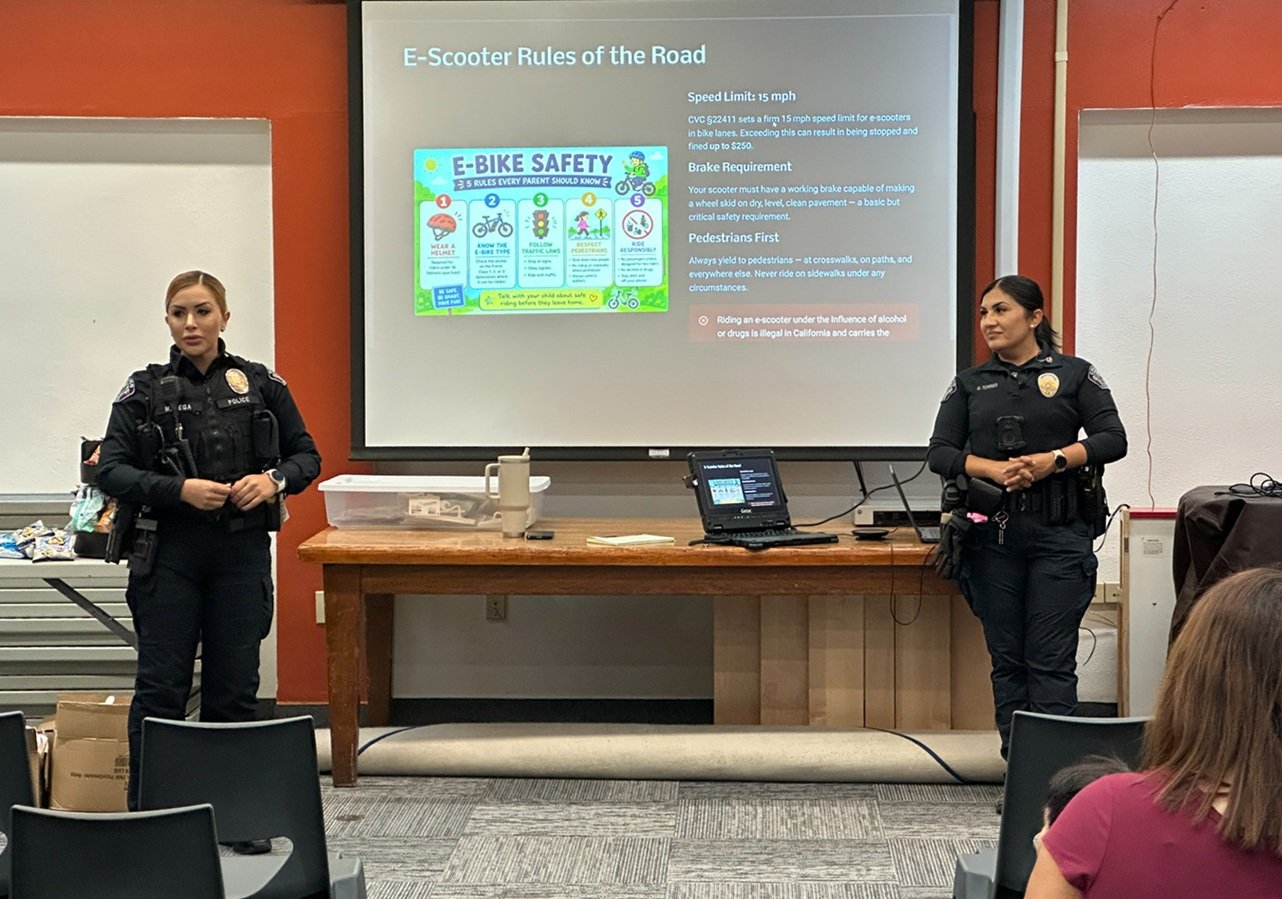
The Calexico Police Department hosted an e-bike and e-scooter safety presentation at the Camarena Memorial Library, 850 Encinas Ave., providing parents and community members with information on California laws, safety requirements, and the growing use of electric bicycles among youth. The presentation, led by Officers Gabriella Torres and Miriam Vega, focused primarily on helping parents understand the responsibilities associated with e-bike ownership and operation.
 During the presentation, officers explained that a legal e-bike in California is a bicycle equipped with fully operable pedals and an electric motor of 750 watts or less. They outlined the three classifications of e-bikes recognized under state law. Class 1 bicycles provide pedal-assist only and stop assisting at 20 mph, while Class 2 models include a throttle and can also reach speeds of up to 20 mph. Class 3 e-bikes provide pedal assistance up to 28 mph and are subject to additional regulations, including age restrictions and equipment requirements.
Torres and Vega emphasized that riders of Class 3 e-bikes must be at least 16 years old under California law. They also noted that all e-bikes are required to display a manufacturer-issued class label and warned against modifying or tampering with motors, speed limiters, or classification stickers. Altering an e-bike to exceed legal power or speed limits can result in the vehicle being reclassified as an unregistered motor vehicle, potentially leading to citations, impoundment, and other penalties.
The officers reviewed where e-bikes may be legally operated. Class 1 and Class 2 e-bikes are generally allowed on roads, bike lanes, and many multi-use paths where traditional bicycles are permitted. Class 3 e-bikes are restricted to roads and bike lanes and are not allowed on sidewalks or most shared-use paths because of their higher operating speeds. Local governments and agencies may impose additional restrictions on trails, parks, and other public areas.
Safety requirements were another major focus of the presentation. Officers advised riders to inspect brakes, tires, lights, batteries, and reflectors before each trip. They also highlighted California’s updated lighting requirements, which mandate that e-bikes be equipped with a white front light visible from 300 feet and a rear red reflector or flashing red light during operation. Helmets are required for all riders under 18 on Class 1 and Class 2 e-bikes and for riders of all ages operating Class 3 models.
The presentation also addressed traffic laws applicable to e-bike riders. Officers reminded attendees that e-bike operators must obey stop signs, traffic signals, and lane markings, travel in the same direction as vehicle traffic, and yield to pedestrians when appropriate. Reckless riding, racing, weaving through traffic, or riding under the influence can result in citations and other legal consequences.
Data presented during the program highlighted the increasing number of e-bike-related injuries and the elevated risk among younger riders. Officers stressed that proper helmet use remains one of the most effective ways to reduce the risk of serious head injuries in a crash.
A significant portion of the presentation was directed at parents. Officers encouraged them to verify the class of e-bike their children are riding, ensure helmets are worn consistently, monitor where their children ride, and perform regular equipment inspections. The presentation also reviewed parental liability under California law, noting that parents may be held financially responsible for damages caused by minors involved in e-bike-related incidents.
The session concluded with information on e-scooter regulations, including California’s 15 mph speed limit for scooters operated in bike lanes, equipment requirements, and the obligation to yield to pedestrians. Officers encouraged parents and riders alike to become familiar with applicable laws and safety practices to help reduce accidents and promote responsible use of e-bikes and e-scooters throughout the community.