-Editorial
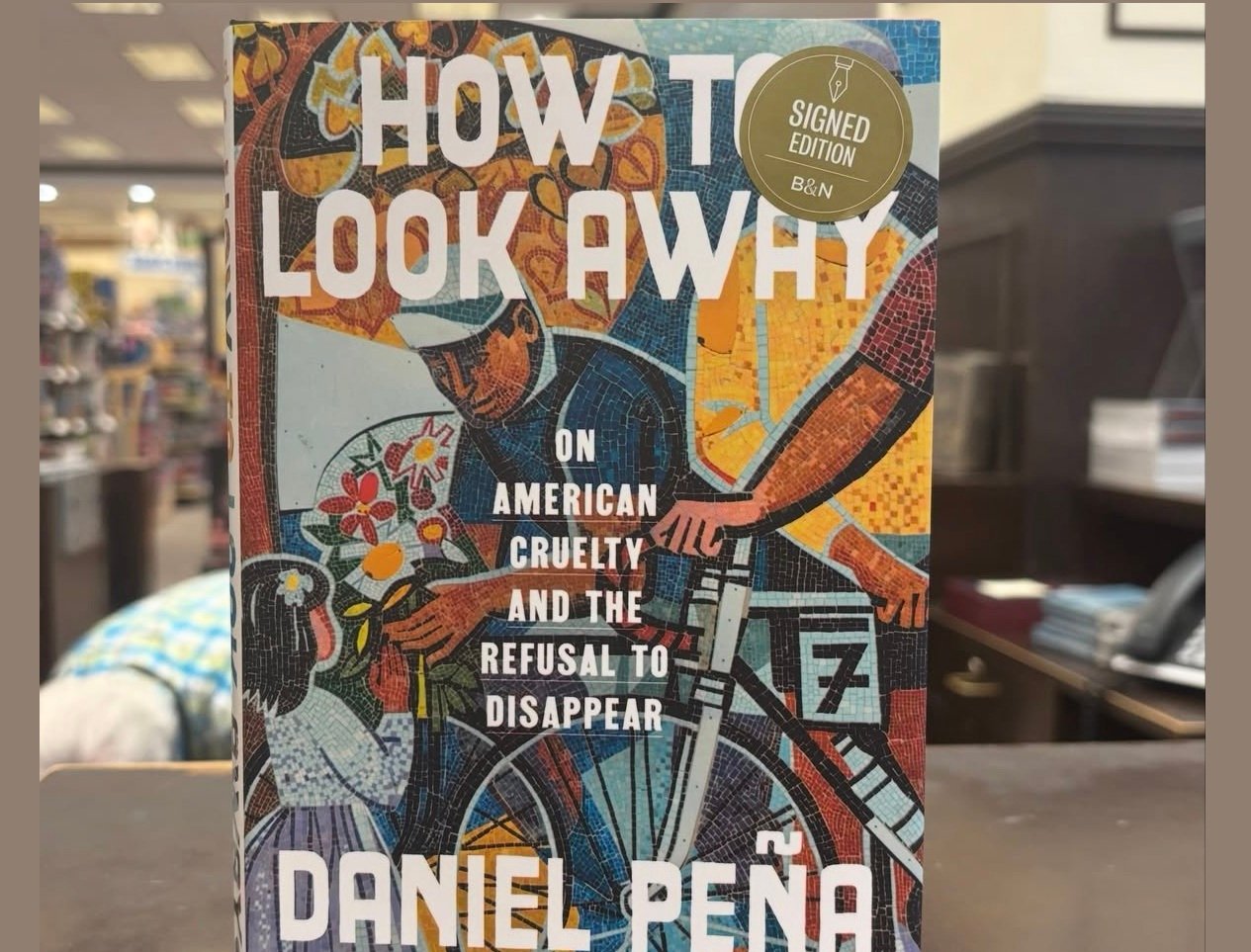
Author Daniel Peña examines immigration, deportation, family separation, and the consequences of violence in his new essay collection, “How to Look Away,” released Oct. 6 by One World.
Drawing on years of reporting, personal experiences and encounters with people affected by U.S. immigration policies, Peña explores how individuals and communities respond to suffering, preserve their dignity and maintain connections despite circumstances that separate them from their families and homes.
The collection combines investigative reporting, personal reflection and narrative storytelling to examine questions of belonging, citizenship and the ways people respond to the suffering of others.
In an interview, Peña said the inspiration for the book emerged from a question raised by writer Susan Sontag and later explored by BBC war correspondent Allan Little: What responsibility do people have toward the pain of others?
For Peña, that question became increasingly relevant as he examined immigration enforcement, detention and deportation in the United States.
“For me, I was thinking through their interpretations as it applied to this contemporary moment in which the pain of others is everywhere,” Peña said.
He argues that violence, which he defines broadly to include institutional practices and social treatment, contributes to divisions between people who exercise power and those subjected to it.
“And that is the core argument of the book,” he said.
The title, “How to Look Away,” reflects Peña’s interest in how repeated exposure to suffering can gradually make people less responsive to it.
He describes certain forms of public humiliation and mistreatment as “debasement rituals,” arguing that their repetition can normalize practices that might otherwise provoke public concern.
“The habitual use of violence (or ‘debasement rituals’ as I call them in the book) numbs us in time,” Peña said. “We grow used to such violence once they’re common.”
Although the book addresses politically contentious subjects, including immigration enforcement, Peña said his broader interest is in examining the human consequences of these experiences and the ways individuals respond to them.
Among the people featured in the collection are deportees, workers, activists and families navigating difficult circumstances.
Several of their stories originated during Peña’s reporting trips to Mexico City, where he worked as a freelance journalist for publications including NBC and The Guardian.
While covering deportation, he met individuals whose experiences continued to resonate with him long after his initial reporting assignments.
Two of those individuals, Diego and Jesus, became central figures in the collection because of their experiences raising children while living outside the United States following deportation.
Peña said their efforts to maintain relationships with their children were particularly meaningful to him as a father.
“They were, and still are, parenting from afar,” Peña said. “And so their stories naturally made it into the book.”
Their experiences allowed him to explore not only the emotional consequences of deportation but also the ways parents attempt to preserve their identities and family relationships across international borders.
“I think the book is as much about how we preserve our own dignity once it has been stripped from us as it is about consuming the pain of others,” he said.
Peña said the stories of Diego and Jesus remained with him after he completed the manuscript because of the personal nature of fatherhood and the trust they placed in him as a writer.
He described their willingness to share intimate details about their lives as an important part of the reporting process.
Beyond hardship, the collection also examines humor, joy and resilience.
Peña said he wanted readers to understand the people featured in his essays as individuals with complex personalities rather than defining them exclusively through difficult experiences.
For the deportees he interviewed, humor frequently served as a way of coping with separation and uncertainty.
“I think humor is chiefly how we salvage our dignity,” Peña said.
He noted that Diego and Jesus often used jokes to navigate conversations about painful circumstances, something he associated with experiences within the Mexican diaspora.
Including those moments, he said, was necessary to portray their personalities more completely.
Peña also incorporated humor into his personal essays, using it to reflect on his own experiences and avoid presenting every subject through a solemn perspective.
The author’s background as a dual citizen of Mexico and the United States also influenced his approach to the collection.
Peña said living with connections to both countries shaped his understanding of identity, migration, and belonging.
He described the experiences of people whose lives extend across the U.S.-Mexico border as more common than they are sometimes portrayed.
“I think a lot of folks whose lives are bifurcated by the U.S.-Mexico border feel this way,” Peña said.
He also emphasized the geographic mobility of Mexican communities, describing his own connections to Mexico City, Austin, Dallas and Germany.
“We’re a moving people, Mexico’s diaspora,” Peña said. “Where the road goes we will ride.”
For readers in Imperial Valley and other communities along the U.S.-Mexico border, Peña believes the book’s examination of identity and belonging may carry particular relevance.
He described much of the collection as a meditation on how people establish a sense of belonging despite legal, political, and social definitions that may not fully reflect their experiences.
“We belong everywhere because we’re human,” he said.
Peña said the collection took approximately four years to research and write, with some essays developing from previously published work.
About one-third of the essays had been assembled when he secured a publishing contract, while the remaining two-thirds were written afterward.
Earlier versions of some essays appeared in publications including The New York Times and the literary magazine Ploughshares.
The writing process coincided with the birth of Peña’s son, creating challenges as he balanced fatherhood with research and manuscript deadlines.
He recalled writing portions of the book while sleeping only a few hours at a time.
“My son was just born when the book went under contract and so I was drafting most of this book on like three hours of sleep,” Peña said.
He believes those circumstances contributed to the fragmented structure of the early manuscript, which he later revised.
Throughout the process, Peña said he relied on journalistic verification even when writing about personal memories.
He conducted archival research, consulted people who had witnessed events he described, and worked with a fact-checker to corroborate details.
The essay “Kaleidoscope of Ghosts” required particular attention to verifying memories against other accounts and documentary evidence.
“For me, veracity and truth were central to the work,” Peña said.
He added that fact-checking sometimes uncovered information that complicated or expanded his recollections, ultimately strengthening the essays.
Although the collection begins with subjects involving separation, disappearance and the loss of personal autonomy, Peña said its later essays increasingly emphasize physical presence, movement and human connection.
One of the central essays recounts his experience bicycling in Berlin during the COVID-19 pandemic.
After spending an extended period working in isolation, Peña said cycling helped him reconnect with his surroundings and regain a sense of physical and emotional engagement.
“It was revolutionary, for me, to be in my body again after working in isolation for so long,” he said.
The collection concludes with “Letter from Houston,” an essay that examines collective movement and community action.
Peña said he hopes readers recognize the importance of maintaining relationships and participating in community life, even during periods of uncertainty.
“I hope the reader takes away the idea that embodiment, movement, connection, these things make us resilient,” he said.
For Peña, the publication of “How to Look Away” represents both a professional milestone and a personal opportunity to share experiences that have shaped his understanding of the world.
He said some essays feel closely connected to his present life, while others reflect experiences that now seem distant.
“I was a privileged witness to a lot of things I’m still making meaning from,” Peña said.
Peña will hold a book signing for “How to Look Away” on Oct. 22 at 6:30 p.m. at After Hours Bookstore, 623 W. Main St., in El Centro.