-Editorial
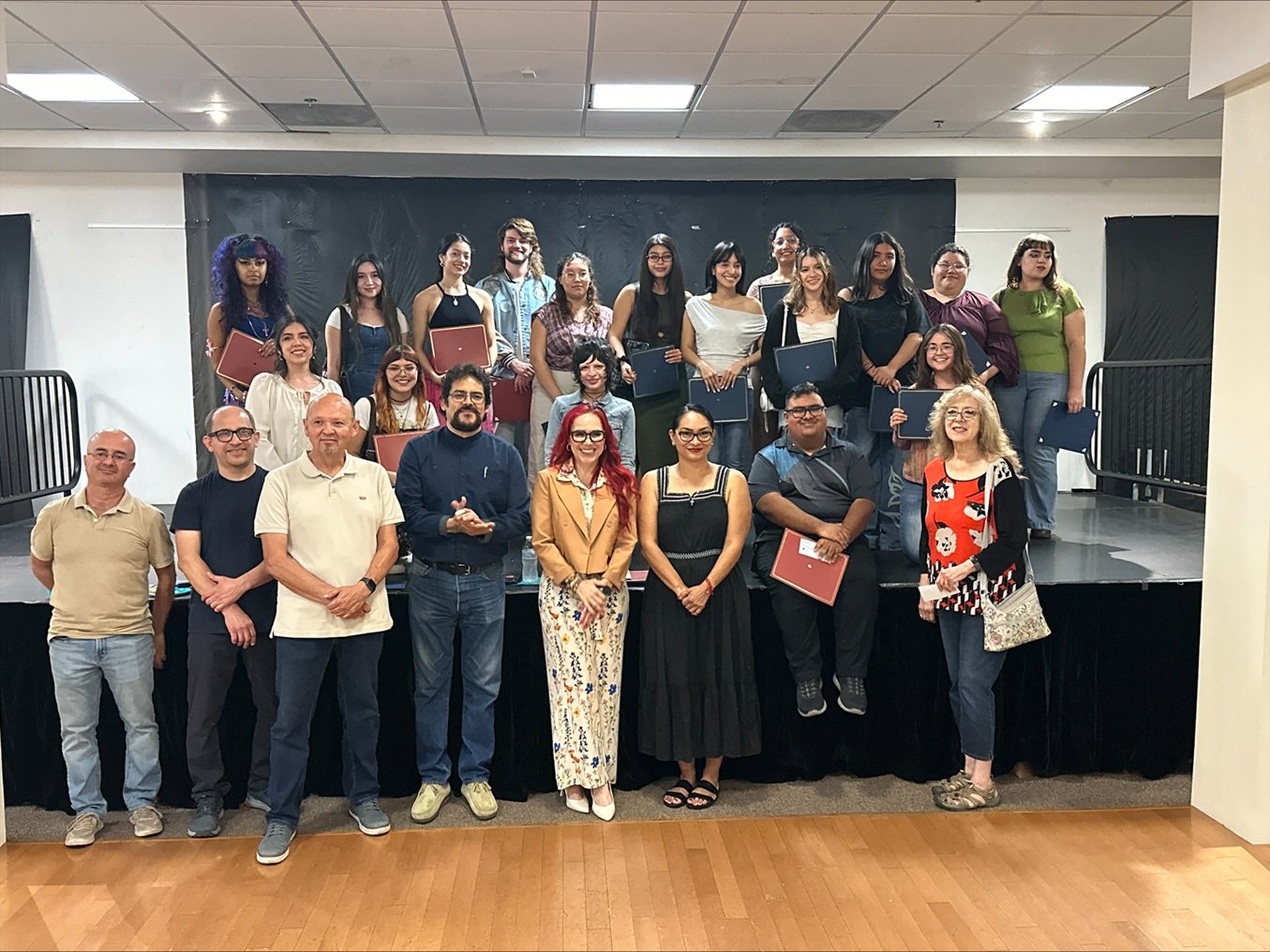
Young artists from both sides of the U.S.-Mexico border showcased their work in Calexico as part of the inaugural Youth Art Contest at the Border, an exhibition highlighting emerging talent from the Imperial Valley and Mexicali.
The contest, organized by the Calexico Recreation Department, Elias-Fontes Art Collection and Calexico Arts Council, received 157 pieces from 78 young artists.
A three-member jury of professional artists, Luis Hernandez, Marco Calderon and Pablo Castañeda, reviewed the submissions and selected 65 pieces by 41 artists for the exhibition.
Calexico Recreation Director Norma Gerardo said the contest was made possible with support from donors and marked the first year of an initiative organizers hope to hold every two years.
“We are very happy with the response,” Gerardo said, noting the number of young artists who participated. She also thanked the judges for volunteering their time to review the submissions.
Marco Calderon, a local artist and one of the judges, said the panel considered multiple elements when evaluating each submission rather than focusing on a single technical characteristic.
“First, I looked at the presentation, how the artist presents their work, which is very important,” Calderon said. “Originality, color, composition, and the message.”
 Calderon said some works communicated their themes more directly than others, but judges also considered the overall character of each piece.
“We don’t look at just one thing,” Calderon said. “We also look at the spirit of the work, and through the work, we also get to know the artist.”
Judging required looking beyond technique and considering how effectively artists used their abilities to create a complete piece, Calderon said.
“Basically, it’s having a good eye for what you’re seeing and seeing whether the artist has enough talent to be a winner,” he said.
The competition included painting, drawing and photography. Calderon said judges attempted to evaluate the different mediums consistently based on the quality of the work.
“We tried to be fair in terms of the quality of the work,” Calderon said. “In this case, it was a selection of painting, drawing and photography, so we looked at everything overall.”
Among the participating artists was Carolina Carrillo, whose work “Jaula de Oro” featured two masks constructed entirely from recycled materials. Carrilo was selected as an Honorable mention in the competition.
“The two pieces are masks, and both are made completely with recycled material,” Carrillo said. “The goal was not to buy anything, for everything to come from recycled materials.”
Carrillo said some of those materials came from clothing that had been intended for donation to migrants but was no longer suitable for its original purpose. Instead of discarding the material, she incorporated portions of it into the artwork.
“We took some pieces that were no longer functional as clothing and used them to make masks,” Carrillo said.
One of the masks is titled “We the People.” Carrillo said the piece draws on the experiences and spirituality of Mexican Americans and incorporates religious iconography to explore the relationship between faith, identity, and migration.
“The mask alludes to Mexican American people who entrust themselves to religious icons and religious imagery,” Carrillo said. “They carry the rosaries and all of this with them,” Carrillo said. “With that, they entrust themselves as they cross, or they live their spirituality.”
Nathaniel Solis, an Imperial Valley College student studying studio arts for transfer, earned first place for his work, “My View on Calexico.”
Solis said encouragement from his parents and sister convinced him to enter the competition despite a busy class schedule. With the deadline approaching, he decided to create an image representing Calexico and its relationship with the border.
The work presents a view of the city featuring buildings and landmarks from different periods of Calexico’s history. Solis included businesses and structures that have closed or been lost, including the former Applebee’s, Denny’s, Robinson Ford, and Garland’s.
“Even though they’re gone, they’re still a part of Calexico and its history,” Solis said.
His drawing also depicts the canal, the international border, Mexicali, and mountains in the background, presenting the communities on both sides of the border within a single landscape.
Solis said he completed the piece in about three days, primarily using alcohol markers and drawing pens. He used rulers for portions of the architectural work but said the image was created without tracing.