-Editorial
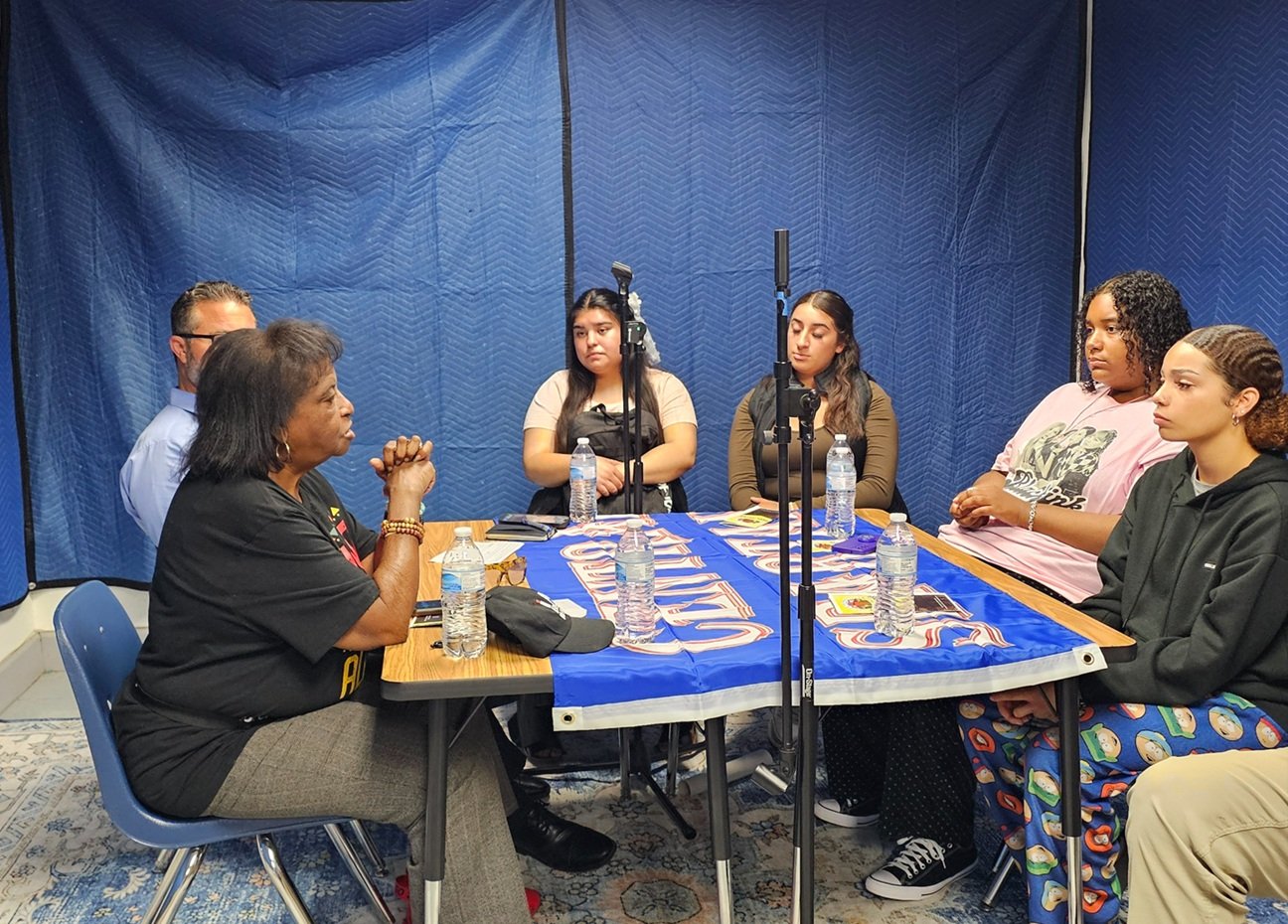
Inside an audio production classroom at Central Union High School, students are learning more than how to mix music, adjust sound levels, and work behind a microphone. They are producing podcasts that carry their voices and the stories of the Imperial Valley beyond the classroom.
Under the direction of teacher Dr. Thomas Tacke, students produce Valley VibeZ, a youth-focused program broadcast locally on Power 98.3 FM, and Voices del Valle, a narrative podcast produced in partnership with KPBS. Students also produce Inside the Blue Zone, which focuses on the experiences of student-athletes.
 The programs grew out of Tacke’s audio production and electronic music courses, which developed from his desire to give students a more hands-on alternative to traditional music appreciation classes.
“I wanted to have some type of hands-on class,” Tacke said.
The program began taking shape in 2018 as students used Soundtrap, an online digital audio workstation, to compose music and beats on their Chromebooks. Podcasting eventually became another component of the class.
Because the platform operated online, Tacke said the course was able to continue functioning during the COVID-19 pandemic while students were learning remotely.
Podcasting gained additional momentum when students participated in NPR’s Student Podcast Challenge. In 2021, a Central student production about male high school athletes and expectations surrounding showing emotion received an honorable mention among thousands of submissions.
The experience led Tacke to consider expanding the students’ work.
Valley VibeZ developed after Tacke contacted Javier Fimbres, General Manager at Power 98.3, about a Christmas rap produced by one of his students. Tacke said the station aired the song regularly for about a week, opening the door to discussions about creating a student-produced program.
Tacke initially envisioned producing a show once or twice a month. Instead, the station wanted a weekly program.
The result was Valley VibeZ, a show focused on culture, community issues, music, and other subjects from a youth perspective.
“We’re about making opportunities,” Tacke said.
The program has since expanded its presence on Power 98.3, airing on both Saturdays at 8 a.m. and Sundays at 9 a.m., Tacke said. Although the same program airs both days, the additional airtime has increased its exposure.
Valley VibeZ is primarily interview-driven and allows students to speak with musicians, community leaders, organizations, and others whose work affects the Imperial Valley. Tacke said maintaining a youth voice is an important part of the program, even when adult guests participate.
Students are encouraged to make interviews conversational rather than relying on a strict question-and-answer format.
“I like them to think that they’re having a lunchtime conversation,” Tacke said.
Voices del Valle takes a different approach.
The program was developed after Tacke submitted a proposal to KPBS, which was seeking locally produced content from San Diego and Imperial counties. Rather than emphasizing interviews, Voices del Valle focuses on narrative storytelling and coming-of-age experiences.
Last season included 11 episodes. The current season began on Labor Day and is scheduled to include 12 episodes released on Mondays.
Guests have included people with connections to the Imperial Valley and surrounding region. Last season featured actor Donal Logue, jazz recording artist Walter Beasley, and Marco Peralta, all Central graduates, Tacke said.
This season’s guests include guitarist Eugene Edwards, former NFL player Cedric Thompson, and California Chief Justice Patricia Guerrero. Edwards grew up in Yuma, while Thompson attended school in Calipatria and grew up in Bombay Beach.
“Voices is different than Valley VibeZ in that it is story-based,” Tacke said. “It’s more of a narrative rather than an interview.”
The third production, Inside the Blue Zone, allows Central student-athletes to discuss their sports, seasons, and experiences balancing athletics and student life.
Students participate in multiple stages of production, including recording, editing, and developing introductions. Tacke said Valley VibeZ episodes generally run between 35 and 50 minutes, while Voices del Valle episodes are usually about 20 to 25 minutes. Inside the Blue Zone episodes are kept shorter, often around nine minutes.
The technical side of the program has also evolved. Early Valley VibeZ productions used microphones that were originally intended for live musical performances before students experimented with lapel microphones. Tacke later worked with Power 98.3 personnel to improve audio quality and began using Adobe Audition to normalize recordings.
Funding associated with Voices del Valle allowed the program to purchase upgraded microphones and other equipment.
Tacke teaches about 150 students across five class sections each day, and podcasting opportunities are available to students interested in participating.
For 17-year-old senior Athena Merino, who hopes to become a paramedic, the student-driven nature of the program is part of its appeal.
“Dr. Tacke is pretty hands-off when it comes to the audio production side of things,” Merino said. “He wants to make sure that the student-led podcast is student-led.”
Merino said students develop ideas while Tacke helps them refine those concepts and prepare them for publication.
Among her experiences was an interview with online commentator Kyla Turner for a discussion about feminism. Merino said she discovered Turner through YouTube and contacted her by email to arrange the interview.
She has also participated in programs featuring local and regional personalities, including Walter Beasley.
Hearing stories of people who came from smaller communities has given her a different perspective on what students from the Imperial Valley can accomplish, Merino said.
Merino is developing a Valley VibeZ segment highlighting locally owned restaurants. She plans to visit restaurants, try their food, and interview owners about how their businesses began.
“I would like to pass that off to the future generation to just keep exploring the valley and meeting new people,” Merino said. “We are a community, so we should at least talk to each other and find out more.”
The program has also introduced senior Abigail Gutierrez, 17, to podcasting.
Gutierrez, Central’s senior class president, said she enrolled after hearing positive comments about Tacke’s classes from other students. She plans to pursue business management after high school but said audio production has helped her develop communication and social skills.
Gutierrez recently completed her first podcast and said the prospect of hearing her voice broadcast on Power 98.3 was something she had never expected.
“A year or two ago, I would have never thought that I would ever be doing a podcast,” Gutierrez said. “It’s something new. It’s a good experience.”
She said she hopes to spend the remainder of her senior year interviewing more Imperial Valley residents and giving them a platform to share experiences that might otherwise receive little attention.
“A lot of people have crazy stories from the valley, and not a lot of it can be told,” Gutierrez said. “I think this is a really good program. It’s just starting up, and it’s gonna get way better over the years. It’s already getting better right now.”
For junior Nicolas Ivan Weir, the class combines two interests: music and interviewing.
Weir plays guitar and is also involved in Central’s rock combo class. He initially enrolled in audio production because he wanted an opportunity to create electronic music, but podcasting has given him another way to explore the local music scene.
“I’m thinking about just interviewing more local bands, just meeting more people, obviously, for the podcast,” Weir said.
Tacke said the program’s future will depend partly on how students and the community use the platform. Local organizations have already approached the class about participating in podcasts, while students have produced episodes involving groups such as Goodwill Industries and the Imperial Valley Food Bank.